Lesson 2: How orbits work
An orbit is falling and missing the ground, over and over, at about eight kilometers every second.
Newton’s cannon
Newton imagined a cannon on a very tall mountain. Fire a ball slowly and it falls nearby. Fire faster and it lands farther away. Fire fast enough and the ground curves away beneath the ball as fast as the ball falls. It never lands. That is an orbit.
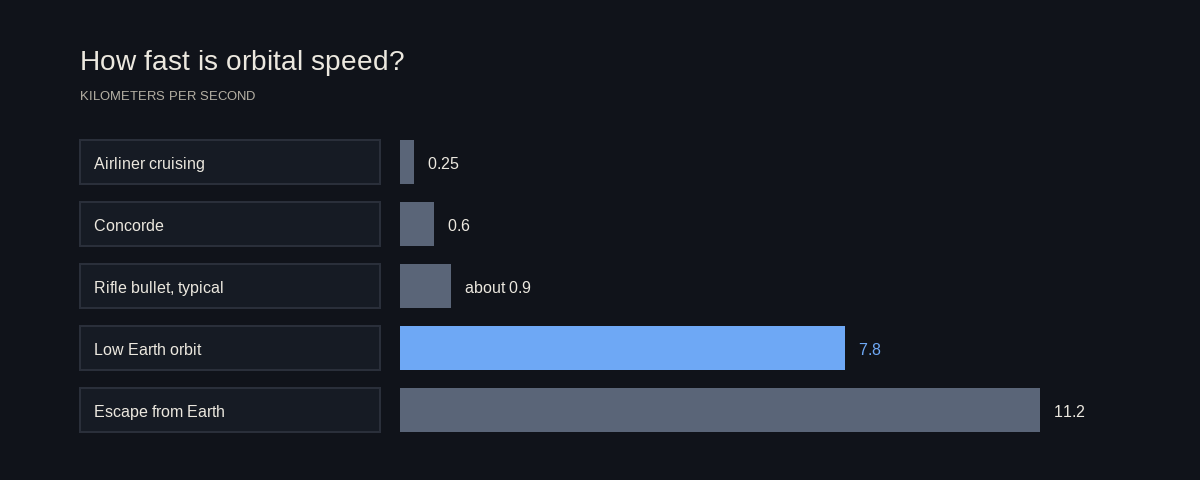
Near Earth, fast enough is about 7.8 kilometers per second, or 28,000 kilometers per hour. The space station, about 400 kilometers up, travels at about 7.7 kilometers per second and circles the planet in roughly 90 minutes.
Why astronauts float
Gravity at the space station’s height is about 90 percent as strong as on the ground. Astronauts float because they and the station are falling together. Nothing pushes up on them, the same way you feel light at the top of a roller coaster drop.
Higher and slower
Higher orbits are slower and take longer. At 35,786 kilometers, an orbit takes one day, matching Earth’s spin. A satellite there seems to hang over one spot, which is why TV and weather satellites use it. The Moon, at about 384,000 kilometers, takes about 27 days to go around.
To leave Earth completely, you need escape speed: about 11.2 kilometers per second from the surface, if air did not slow you down.
Try it
Swing a ball on a string in a circle. The string is gravity, pulling the ball toward the center. Let go and the ball flies off in a straight line. In orbit, gravity never lets go. Next, find out why reaching this speed is so hard in lesson 3, the rocket equation.
Common questions
Why do rockets launch east?
Earth spins east. At Cape Canaveral, the ground already moves at about 0.4 kilometers per second, which gives an eastward launch a free head start.
Is there gravity in space?
Yes. Gravity keeps the Moon and satellites in orbit. Astronauts feel weightless because they are in free fall.