Lesson 3: The rocket equation
One short equation, written in 1903, explains why a rocket on the pad is about 90 percent propellant.
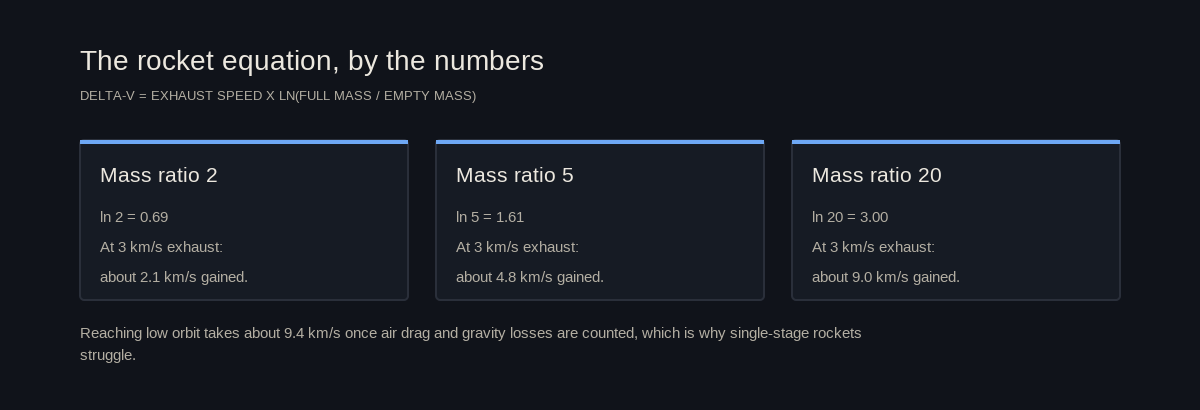
The equation
In 1903 the Russian schoolteacher Konstantin Tsiolkovsky published the equation every rocket engineer still uses. The change in speed a rocket can gain, called delta-v, equals its exhaust speed times the natural logarithm of its full mass divided by its empty mass.
The logarithm is the catch. Doubling the propellant does not double the speed. To gain a little more speed, you need a lot more propellant, and that propellant has to be lifted too.
Worked numbers
Take an engine with an exhaust speed of 3 kilometers per second. If the rocket is half propellant, the mass ratio is 2, and the natural log of 2 is about 0.69. The rocket gains about 2.1 kilometers per second. With a mass ratio of 5, it gains about 4.8. With a ratio of 20, about 9.0.
Getting to low Earth orbit takes about 9.4 kilometers per second once you count losses to gravity and air. So a single-stage rocket would need to be 95 percent propellant, with everything else, including tanks, engines and payload, squeezed into 5 percent.
Why stages
Staging solves this. When the first stage runs dry, it drops away, and the upper stage starts fresh with a much better mass ratio because it no longer carries the heavy empty tanks. Saturn V had three stages. Falcon 9 has two, and its first stage flies back to be used again.
Try it
Use a calculator with a natural log button. Pick an exhaust speed of 4.4 kilometers per second, about what a hydrogen engine reaches, and see what mass ratio gets you to 9.4. Then try 3.0 for a kerosene engine. To see real rockets that solved this, visit our sister site Florida Space Academy.
Common questions
Who was Tsiolkovsky?
A deaf, largely self-taught Russian schoolteacher who worked out the basics of spaceflight, including the rocket equation and multi-stage rockets, decades before anyone built one.
Why not use a better fuel?
Better fuels help, and hydrogen gives the highest exhaust speed of common propellants. But hydrogen is bulky and very cold, so tanks get bigger and heavier. Every choice is a trade.