Lesson 1: Newton's third law and thrust
A rocket does not push on the air. It pushes on its own exhaust, which is why it works best in space.
The rule
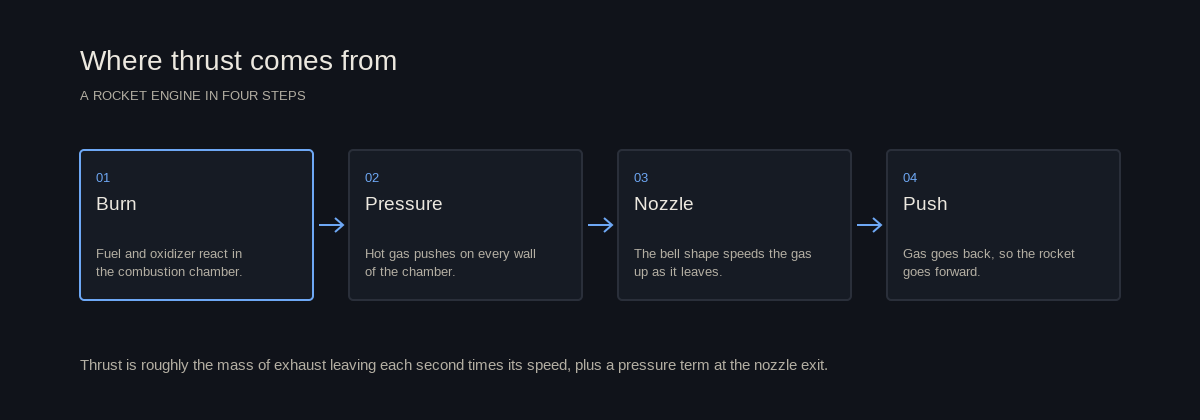
Isaac Newton’s third law says that for every action there is an equal and opposite reaction. When a rocket engine throws gas out the back, the gas pushes back on the rocket just as hard. That push is thrust. Nothing outside the rocket is needed, which is why rockets work in the vacuum of space.
In 1920 a New York Times editorial mocked the physicist Robert Goddard for claiming a rocket could work in a vacuum. In July 1969, as Apollo 11 flew to the Moon, the paper printed a correction.
How much push
A simple way to estimate thrust is to multiply the mass of exhaust leaving each second by how fast it leaves. A large liquid-fuel engine burns hundreds of kilograms of propellant every second and throws the exhaust out at around 3 kilometers per second. That makes millions of newtons of force.
The bell-shaped nozzle matters. Hot gas in the chamber is at high pressure. The nozzle turns that pressure into speed, the same way a garden hose nozzle speeds up the water.
Try it: the balloon rocket
Thread a string through a drinking straw and tie it across a room. Blow up a balloon, hold the neck shut, and tape it to the straw. Let go. The balloon pushes air out the back and shoots along the string. Try a bigger balloon, or a narrower neck, and compare distances.
You have just run a rocket test. Real engineers measure the same things: how much mass leaves, how fast, and for how long.
Next lesson
Thrust gets a rocket moving. To stay in space, it needs to go sideways very fast. That is lesson 2, how orbits work.
Common questions
Do rockets need air to burn fuel?
No. Rockets carry their own oxidizer, usually liquid oxygen, so they can burn fuel in space.
Is thrust the same as speed?
No. Thrust is a force. It makes the rocket speed up. How fast the rocket ends up depends on how long the engine burns and how heavy the rocket is.